
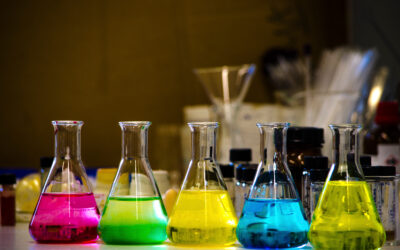
Colorful solution in conical flask lined on a bench in a chemistry lab with blur background organic chemistry experiment photography for background use
Understanding the Differences.
While the terms Muriatic Acid and Hydrochloric Acid (HCl) are often used interchangeably, they refer to the exact same chemical compound—an aqueous solution of hydrogen chloride gas. The difference between them is primarily one of purity, concentration, and application.
This distinction is crucial for safe handling and determining suitability for laboratory versus commercial use.
The Fundamental Identity: HCl
Both muriatic acid and hydrochloric acid are the same strong acid.
| Feature | Description |
| Chemical Formula | HCl (Hydrogen Chloride) |
| Chemical Nature | A strong acid that fully dissociates in water, making it highly corrosive. |
| Historical Name | The name “muriatic” comes from the Latin word muriaticus, meaning “pertaining to brine or salt,” as it was historically produced from rock salt. |
Hydrochloric Acid: The Pure Form
“Hydrochloric acid” is typically the term used for the high-ppurity, reagent-grade chemical.
Purity: Very high (often 35% to 37%HCl by mass). It is essentially just hydrogen chloride gas dissolved in pure water.
Color: It is colorless and transparent.
Primary Use: Scientific research, laboratory analysis, high-end industrial processes, and food processing (where purity is paramount).
Availability: Usually sold through chemical supply houses and requires specialized handling due to its high concentration and purity.
Muriatic Acid: The Commercial Grade
“Muriatic acid” is the name given to the commercial or technical grade of hydrochloric acid.
Purity: Lower than laboratory-grade HCl. It is considered a diluted and impure version.
Concentration: Typically sold at a lower concentration, usually ranging from 10% to 31.5%HCl.
Color: It often has a yellowish or slightly orange tint. This color is the most obvious visual difference and is caused by the presence of trace impurities, most commonly iron chloride (FeCl3).
Primary Use: Heavy-duty cleaning, masonry work (etching concrete or cleaning mortar), and adjusting the pH of swimming pool water.
Availability: Widely available at hardware and pool supply stores.
| Property | Hydrochloric Acid (Reagent/Lab Grade) | Muriatic Acid (Commercial/Technical Grade) |
| Purity | High | Lower (Contains trace impurities) |
| Concentration | Higher (Up to approx 37%) | Lower (Typically $10% to $31.5%) |
| Color | Colorless | Yellowish/Slightly Orange (Due to iron) |
| Cost | More expensive | Less expensive |
| Primary Use | Laboratories, refined industrial applications | Household cleaning, pool maintenance, masonry |
In essence, while they are chemically the same corrosive agent, muriatic acid is a less pure, more common, and typically more dilute version of the chemical that chemists call hydrochloric acid.